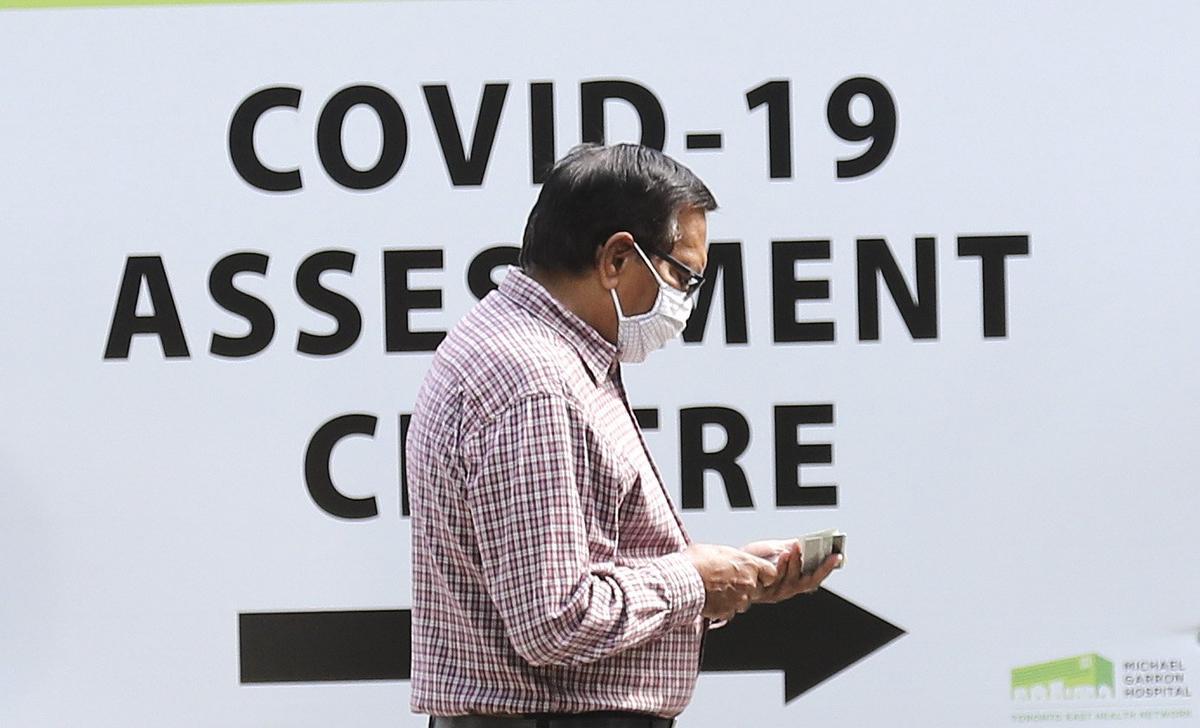
The second coming of COVID is here. Though it appears to have made a loitering stop in Peel, put its feet up, made itself at home.
While Ontario braces itself for Coronavirus: The Sequel, either woefully unprepared for another round of contagion or prophylactically buffered, depending on who you trust — doctors or politicians — the Region of Peel has already borne the brunt of a revisit. If, in fact, it could be said that COVID-19 ever left, to the level of Stage 3 unshackling, which only happened on July 31.
Peel is a diverse and varied sprawl, from Caledonia, where more than 40 per cent of the population has been in Canada for three generations or more — as per the most recent census, 2016 — to Brampton, where 73.3 per cent of the population are visible minorities. Overall, 35.5 per cent of Peel residents were born in India, 51.5 per cent are immigrants, and 14 per cent of immigrants call Mississauga home.
Is any of that data relevant to the alarming figures disclosed by Dr. Monica Hau, Peel’s associate medical officer of health, at a press conference last week? Probably, although statistics don’t particularly provide any perspective more insightful than a surface contour, a topography.
But the city of 700,000 northwest of Toronto, less than half the size of Toronto, had more active cases of COVID-19 reported than any other public-health unit in the province according to figures as of last Wednesday — 451 — scaling heights over last week not seen since June, with about three-quarters of the new infections diagnosed in Brampton. As of Tuesday, cumulative active cases in Peel were 546, according to Public Health Ontario.
Part of that spike — at least 55 cases — is connected to a major workplace outbreak, the whence of it kept under wraps by Peel public health officials, who take the view that it serves no purpose to identify the source. That’s a regrettable posture; the public has a right to know if there’s a point of origin just up the street. Treating COVID-19 like a taint, rather than the generally random illness it is, only promotes a sense of stigma, even shame.
And Lord knows there was plenty of shaming on social media — attached to culture, ethnicity and practices to every immigrant wave that has settled in Canada — when the Peel statistics were publicized. Among those who took understandable offence to the instant stereotyping was one Naheed Dosani, who tweeted: “Brampton is now the epicenter of Ontario’s #COVID19 crisis. Rather than racial gaslighting South Asians, POC & those in multigenerational homes, let’s try to learn how people’s vulnerabilities are shaped by their circumstances.”
Dr. Dosani is a palliative care physician and health justice activist who founded Palliative Education and Care for the Homeless (PEACH).
“I wrote that tweet because it was very apparent, looking at comments on social media and also the way it was being discussed in the media, that there seemed to be a description of a kind of people that were behaving in a certain way that was contributing to COVID-19,” Dosani tells the Star. “There are a lot of assumptions in how South Asians and people of colour live differently in a higher concentration like Region of Peel, how they behave.”
It was surely not the intention of Peel Public Health to stereotype any community. However, there was an attempt made by both officials and media to explain the numbers, the apparent contributing factors, and this narrative reinforced an aspect of blame — particularly the takeaway that the coronavirus was being spread, to some extent, by people living in multi-generational households and individuals who’d travelled to severely struck countries such as India (second highest number of cases globally, 4.4 million, a jump of almost 100,000 cases within a 24-hour period on Friday) and Pakistan.
Visiting family in ancestral countries is hardly exclusive to South Asians. Sloppy behaviour can’t be assessed racially or ethnically.
Still, as a contributing factor, it can’t be ignored — with 58 per cent of Peel’s COVID cases (from February to September) in Brampton, with an infection rate of 711 per 100,000 people, while neighbouring Mississauga has seen just 390 infections per 100,000 people.
Data is easily exploited. Which is why collecting race-related statistics is such a dicey proposition. We did already know, however, from data gathered by Toronto Public Health, that COVID is taking a disproportionate toll on racialized and low-income groups. In that context, the coronavirus does discriminate.