Subscripe to be the first to know about our updates!
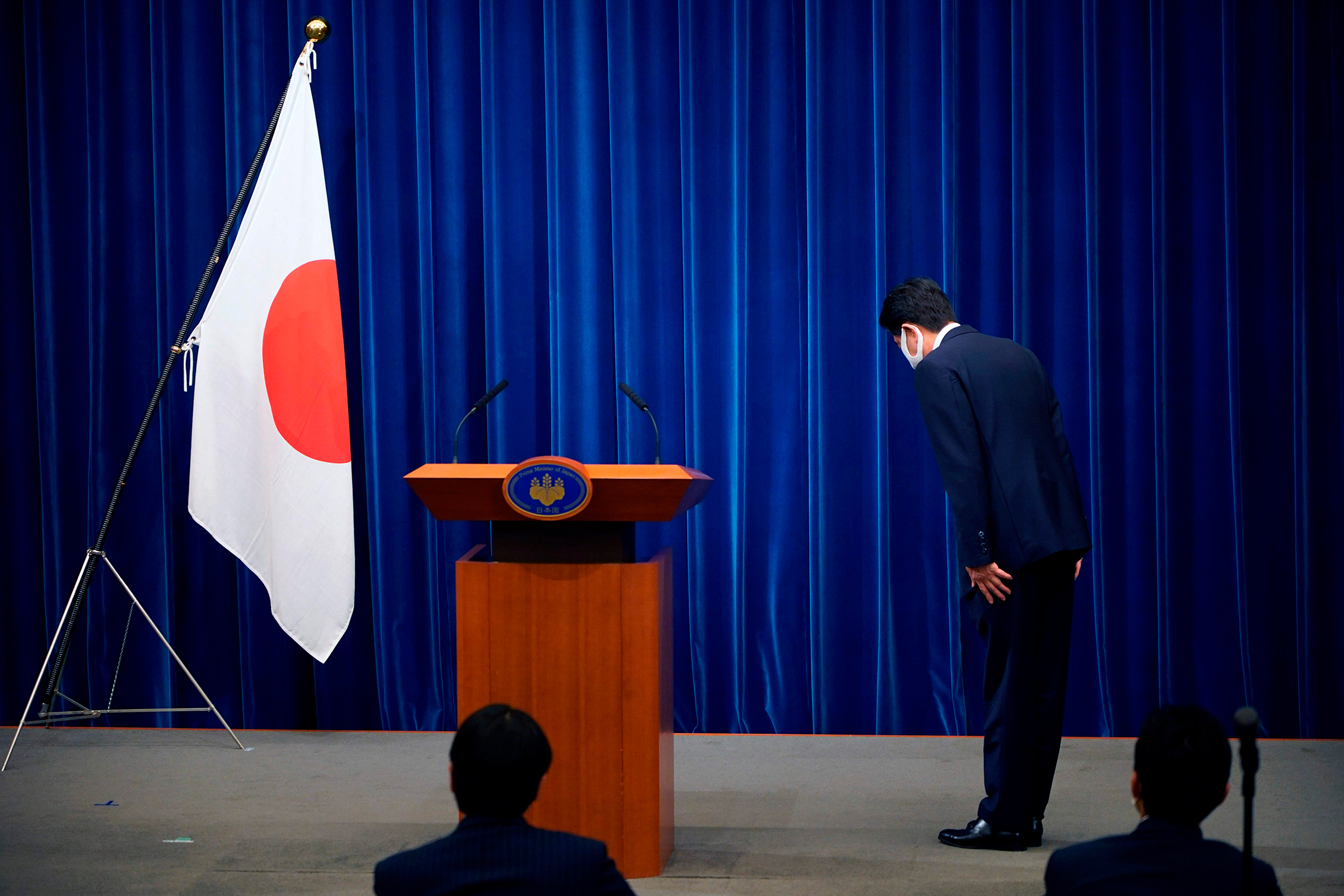
Japan’s new leadership after Abe’s resignation
Date & time :
Monday, 5 October 2020
Cho Eun-il
On Sept. 16, Yoshihide Suga took office as prime minister of Japan after serving as the chief cabinet secretary throughout Abe’s nearly eight-year term. Two weeks after Shinzo Abe’s decision to step down, Suga won a landslide victory in the election for leadership of Japan’s Liberal Democratic Party (LDP), defeating former Foreign Minister Fumio Kishida and former Defense Minister Shigeru Ishiba.
Suga is expected to stay in office until the next election in September 2021, focusing on the coronavirus pandemic and economic reform policies. But there is a possibility to call a snap election this year if Suga decides to consolidate his power in the long run.
Abe’s legacy
Abe is the longest-serving prime minister in Japan’s postwar history. Before Abe, Japan was known for short-lived prime ministers that led to discontinuities in domestic and foreign policies. During his tenure, Abe brought unusual continuities in Japanese foreign and defense policies and stabilized Japanese politics.
When he started his second term in December 2012, Abe put his priority on extensive economic reform policies widely known as “Abenomics.” Abenomics was a package of monetary and fiscal policies combined with structural reforms. Through Abenomics, Abe aimed to lift Japan’s struggling economy, achieving moderate success. But as the pandemic has hit the world economy, Japan’s economy has slumped marking negative growth.
The Abe administration published the first National Security Strategy (NSS) and established the National Security Council in 2013. Based on the NSS, it reinterpreted the constitution to allow Japan’s right to collective self-defense, strengthen U.S.-Japan defense cooperation under the revised guidelines and expand its international stature vis-a-vis the free and open Indo-Pacific. In recent years, the Abe administration made significant achievements in its China policy.
Although China’s aggressive military posture posed a growing threat to Japan’s security around the East China Sea, Japan managed day-to-day tensions with China and established the Maritime and Aerial Communication Mechanism. Japan expects Chinese President Xi Jinping to visit Japan, after his original official visit was postponed due to the pandemic.
Policy priorities under new leadership
Suga pledges to continue his predecessor Abe’s economic policies. Suga’s continuity policy sends a positive signal amid the pandemic-stricken economy. This is why the Suga administration puts a top priority on rejuvenating the economy.
The Suga government has further pledged to implement monetary and fiscal policies to bring its economy back onto a growth track. Suga prioritizes stabilizing markets and creating millions of new jobs while expecting the postponed Tokyo Olympics next year. But uncertainty over the upcoming U.S. presidential election and a possible third wave of the pandemic will be destabilizing factors for his new leadership.
In foreign and defense policies, the Suga administration favors policy continuity rather than exploring new opportunities as well. This is why Toshimitsu Motegi continues as foreign minister. Also, Suga appointed Nobuo Kishi, who is Abe’s younger brother, as defense minister. By doing so, the Suga administration seeks to further align security policy with the U.S. and build stable relationships with China and Russia.
Similarly, the Suga administration carries on the free and open Indo-Pacific regional strategy by expanding its relations with Australia, India and ASEAN countries. A sudden change in foreign policy can bring uncertainty to Japan’s strategic partners as well as its allies. Thus, Suga will continue Abe’s approach and avoid controversial decisions at least until the next election.
For the Suga administration, setting a new direction for Japan’s NSS is an urgent matter. The Abe administration decided to revise the NSS this year as Japan canceled Aegis Ashore plans due to technical challenges and cost overruns in June. The Abe administration decided to purchase two Aegis Ashore ballistic missile defense batteries from the U.S. in December 2017, in response to North Korea’s nuclear and ballistic missile testing.
After the cancellation of the decision, Abe said that the NSC is discussing deterrence including Japan’s alternative ballistic missile defense options that replace the Aegis Ashore plans. The LDP submitted a proposal that Japan should have strike capabilities to halt ballistic missiles within enemy territory. Now the deciding power has passed to Suga who looks to complete Abe’s legacy.
Implications for Korea-Japan relations
During Abe’s tenure, Japan’s relations with South Korea have worsened considerably. So far, bitter disputes have been common between South Korea and Japan. Not only wartime legacy issues but also trade and military information-sharing agreements became catalysts for deterioration. In this situation, both in Seoul and Tokyo, many are skeptical about any improvements in Korea-Japan relations in the short-term.
The Suga administration is likely to adhere to the stance that the Moon Jae-in government is providing the causes of disputes while moving toward a “normal state” that expands its free and open Indo-Pacific regional strategy and strengthens defense capabilities to improve the deterrence power of Japan.
However, there is no rush for Seoul to presuppose pessimism in dealing with the Suga administration. While concerns remain over key issues such as wartime sex slavery, forced labor and trade restrictions, Korea-Japan relations may begin to warm under Japan’s new leadership.
By; koreatimes