Subscripe to be the first to know about our updates!
EU Recovery Plan Splits CEE, Raises Absorption Capacity Questions
Date & time :
Sunday, 14 June 2020
Anja Vladisavljevic, Claudia Ciobanu
A750 billion-euro recovery plan proposed by the European Commission – the executive arm of the European Union – has been hailed as a major step towards bridging opinion within the bloc over the principle of common debt. But it has opened a new faultline in Central and Eastern Europe.
Building on a proposal from Germany and France, Commission President Ursula von der Leyen unveiled a plan in late May to use borrowed money – repaid jointly over 30 years – to fund the bloc’s economic recovery from the COVID-19 pandemic, though she faces resistance from northern states opposed to the idea of sharing debt with their southern peers.
Italy and Spain are obvious beneficiaries, but so too is Poland, opening a crack in the unity of the Visegrad Four countries – the Czech Republic, Hungary, Poland and Slovakia.
The quartet has frequently mounted a united front on EU policy issues, most notably during the refugee crisis that erupted in 2015 when it rejected relocation quotas to share the burden on the bloc.
But von der Leyen’s plan has now driven a wedge between Poland and Slovakia on one side, and the Czech Republic and Hungary on the other.
Leaders of the four are due to discuss the issue at a meeting on June 11. But experts and officials are sceptical they will bridge their differences.
“We don’t expect to see a strong unified front as we did during the migrant crisis,” said Vit Havelka, an analyst at the Prague-based Europeum think tank.
There is also widespread concern over the capacity of countries in the region to absorb such funds and spend them wisely.
‘Defining moment’
Calling the plan ‘Next General EU’, von der Leyen proposed 500 billion euros in grants to countries hardest hit by the coronavirus and another 250 billion in loans, on top of the EU’s long-term budget for 2021-27 which the Commission proposed to set at 1.1 trillion euros.
For the first time, the Commission would borrow the money on financial markets, using its healthy credit rating to ensure low borrowing costs.
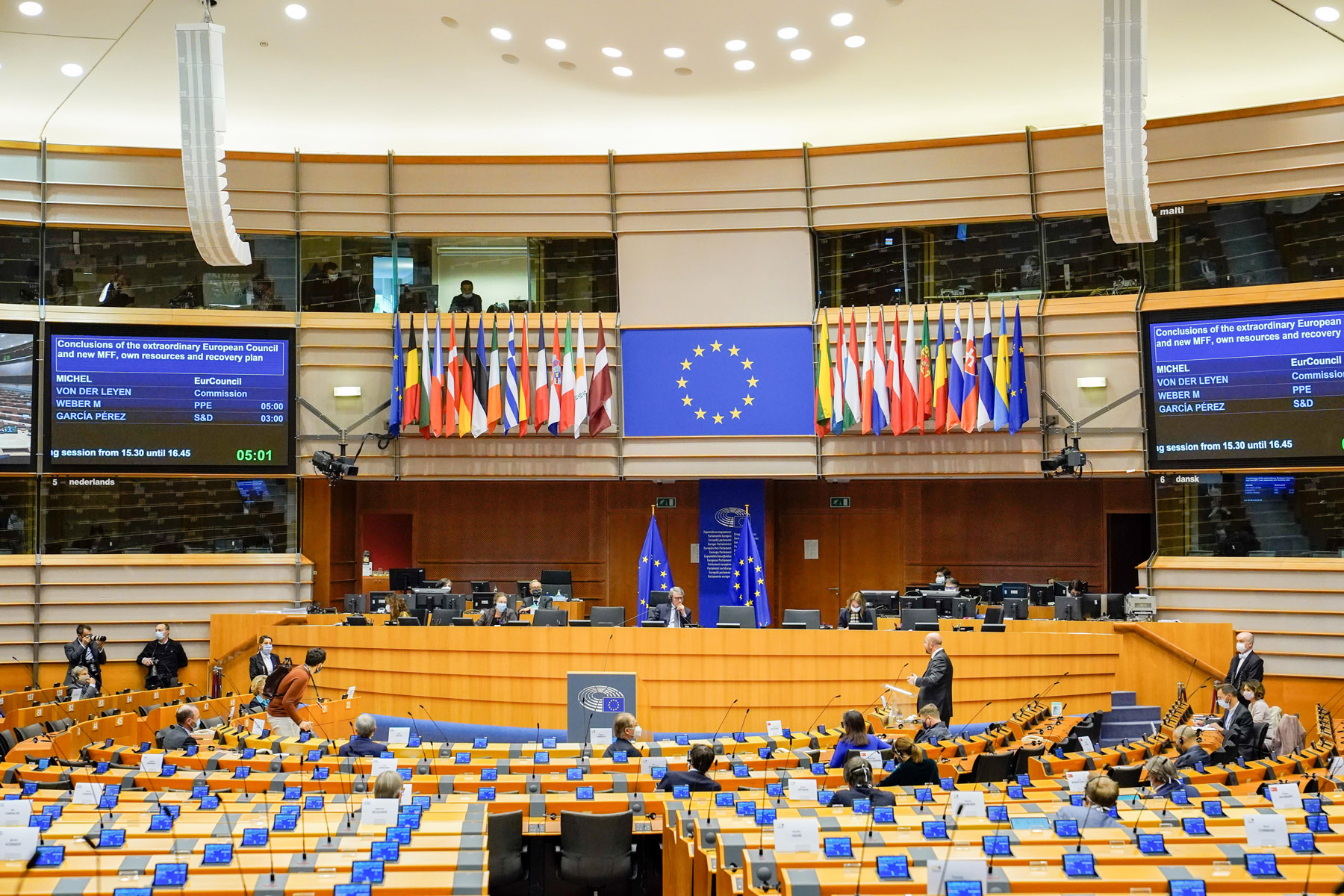
Von der Leyen told European parliamentarians that the bloc faced a “defining moment”.
“What started with a virus so small your eyes cannot see it, has become an economic crisis so big that you simply cannot miss it,” she said.
The plan needs the unanimous support of all 27 members of the bloc, and may yet undergo significant changes.
Czech Republic: ‘Absolutely unacceptable’
Of the Visegrad Four, the Czech Republic voiced the loudest objections.
“These conditions are absolutely unacceptable for us,” Prime Minister Andrej Babis declared.
“They reward EU members with high unemployment and penalise fiscally disciplined EU member states with a low unemployment rate,” he said. “This would put us at a great disadvantage.”
Under the Commission’s initial estimates, Prague would receive 8.6 billion euros in direct payments with another 10.6 billion in loans.
Amid warnings that the Czech Republic risked becoming a net contributor to the EU, European Commission Vice President Vera Jourova – a member of Babis’s Ano party – said that, when structural funds are counted, the Czech Republic would still be about 7.5 billion euros better off from the 2021-27 budget.
But Czech government officials, speaking on condition of anonymity, said Babis’s objections were not only economic. The Czech premier is worried, they said, about the power being vested in Brussels, taking the EU closer to a shared budget and central government.
In opposing the plan, Babis will be counting on the support of fiscally conservative member-states such as Austria, Denmark, Sweden and the Netherlands, but also his Hungarian partner in the Visegrad Four, Viktor Orban.
Orban called the plan “absurd and perverse”. Experts say he is suspicious of debt mutualisation but also of the shift towards greater EU integration. Orban also faces falling out with Poland, which, as the plan’s third biggest beneficiary, has been effusive in its praise.
Poland a big winner
From the recovery fund alone, Poland is set to reap over 37 billion euros in grants and another 26.8 billion in loans.
“Poland persuaded Europe to have an ambitious budget. And we have a success!” Polish President Andrzej Duda tweeted in his first reaction.
Poland is not only happy with the sums coming its way, but also with the spending breakdown.
Warsaw’s earlier concerns about receiving less in terms of cohesion funds in the next budget was offset by extra recovery funds. Funds for the common agricultural policy, another Polish priority, are also set to increase.
Poland has also seen a huge boost in money dedicated to the transition of coal regions, from an original two billion euros to eight billion under the new proposal. Warsaw had stood alone in resisting the EU’s goal of climate neutrality by 2050, arguing it would be too expensive for Poland.
“From the Polish perspective, the most important is the balance between the long-term goal of supporting the economic catching-up of the CEE region and mitigating the impact of the current crisis, especially in southern Europe,” said Zofia Wetmanska, an analyst at the Warsaw-based WiseEuropa think tank.
Like others in the region, however, Poland will pay close attention to conditionality, remaining strongly opposed to the principle of EU money being conditioned on respect for the bloc’s founding principles in terms of rule of law.
Bulgaria, while welcoming the prospect of 12.3 billion euros under the plan, is also concerned about conditionality.
“This is not an easy topic for Bulgaria,” said Alexandrina Ginkova, a journalist on the world desk of Dnevnik.bg.
“It will be interesting to see whether the evaluations will eventually influence the distribution of EU funds.”
Can they spend it?
Visegrad Four member Slovakia as well as Romania and Croatia have all welcomed their respective portions of the proposed recovery fund, but there is concern over the administrative capacity of these countries to absorb the money.
Faced with the potentially catastrophic impact of the pandemic on Croatia’s vital tourism sector, Prime Minister Andrej Plenkovic was quick to welcome the Commission’s “very generous funds”.
Plenkovic, whose ruling Croatian Democratic Union faces a parliamentary election this year, said Croatia stood to receive a little over 10 billion euros, three quarters of which would come in the form of grants and the rest in loans. He said he expected Croatia to receive at least the same again from the budget.
But political sciences professor Kristijan Kotarski said questions remained over Croatia’s ability to put the money to best use.
“This is something that Croatia should use well, but we will see how the national administration will be set up, how quickly these funds will be absorbed,” Kotarski told BIRN.
After Spain, Italy, Poland and Greece, Romania is potentially the fifth biggest beneficiary, with some 33 billion euros.
Following lengthy and sometimes bitter debate over EU cohesion funds, the current budget also looks positive for Bucharest.
“From the Romanian point of view … you can’t be against this [recovery] plan,” said Siegfried Muresan, a Romanian MEP and vice-chair of the European People’s Party bloc.
“Its principles are healthy and it is good for Romania to support it,” Muresan told BIRN in a telephone interview, saying he was sure the recovery plan would be adopted in a “similar” form to that proposed by the Commission.
From the recovery plan and the budget, Romania stands to reap a whopping 100 billion euros, a sum the country’s European Funds minister, Marcel Bolos, called “impressive”. But again, capacity is an issue; with an absorption rate of 36 per cent, Romania is three points below the EU median.
“It is a very generous allocation for Romania and a huge opportunity if the latter succeeds in taking advantage of it,” EU affairs expert Dumitru Opritoiu told BIRN.
Slovakia said Christmas had come early.
“This is a chance to take our economy into the 21st century,” said Tomas Valasek, an MP from the Za ludi [For the People] party and head of the foreign affairs committee in the Slovak parliament.
Slovakia, however, has an even worse record than Romania in using EU funds effectively and on time. At 33 per cent, Slovakia’s absorption rate beats only Croatia’s.
“It’s very important to be ready to use this money and to use it for really meaningful things that will help our economy,” said Veronika Remisova, Slovakia’s deputy prime minister for investment and the official in charge of allocating EU funds within the country. Remisova has promised to ease the distribution of EU funds and improve transparency.
Some experts and media outlets have expressed hope that Bratislava will use the money to reinvent the Slovak economy, moving away from the cheap labour model that turned the country into an assembly line for foreign carmakers after the collapse of communism.
Greece also welcome von der Leyen’s plan, which earmarks 22.5 billion euros in grants and another 9.5 billion in loans for Athens.
Taken together with the revised budget, the country stands to receive more than 50 billion euros, or 30 per cent of its national economic output.
“This would allow for a quick recovery and solid economic restructuring,” said economics reporter Yannis Kimpoyropoulos, “but the key issue is what the country will do with this money.”
Source; Balkan Insight